Does Your Pool Barrier Pass? Florida, Arizona and Federal Numbers
Enter your fence height, gaps, gate and latch to compare them with the Florida and Arizona pool barrier statutes and the federal safety commission guidelines, plus Florida's five ways a new pool can pass final inspection. Read November 13, 2026.
Updated
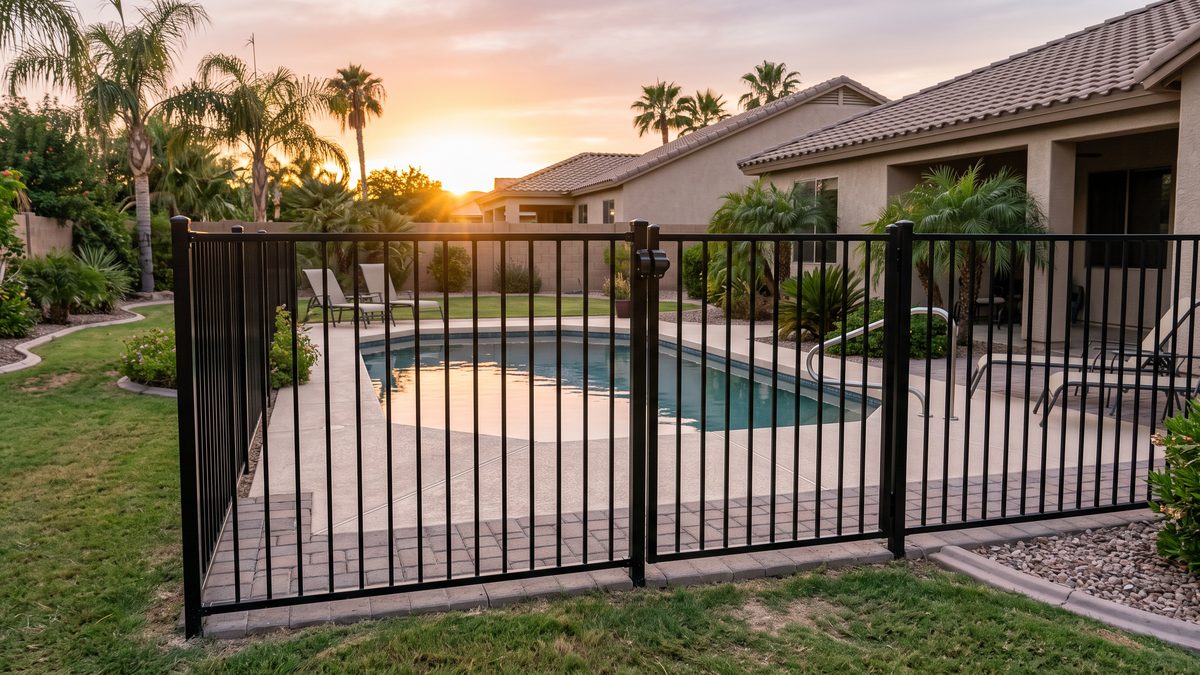
A pool fence that looks fine from the patio can fail on a tape measure. The rules that count are the ones your city enforces, and the state and federal texts show where those rules usually come from.
| Question | Answer, from the texts we read |
|---|---|
| How tall does the fence need to be? | Florida's state barrier standard says at least 4 feet on the outside. Arizona's says at least 5 feet. The federal safety commission recommends at least 48 inches and notes that some places require 60. |
| Must the gate close and latch by itself? | Yes in all three. Florida and Arizona both write it into law, and the federal guidelines say the same, with a gate that opens away from the pool. |
| Is a fence required at all? | In Florida, state law lets a new residential pool pass final inspection with any one of five safety features, and a fence is only one of them. Arizona's statute requires an enclosure around most residential pools, with listed exceptions. Your city or county can ask for more than either. |
Measure your own barrier against all three standards
This compares your numbers with the Florida and Arizona statutes and the federal guidelines. It is not an inspection. Your city can add rules, and a pool built before a law took effect may be treated differently.
Florida's five ways to pass final inspection
Florida's residential pool safety law does not make a fence the only answer for a new pool. To get a certificate of completion, a new residential pool must have at least one of these:
- 1A barrier that isolates the pool from the house and meets the state's barrier rules
- 2An approved safety pool cover
- 3An exit alarm of at least 85 decibels at 10 feet on every door and window that opens from the home to the pool
- 4Self-closing, self-latching doors to the pool, with the release no lower than 54 inches above the floor
- 5A pool alarm that sounds when someone enters the water, certified to the ASTM F2208 standard
A person who fails to equip a new pool with one of these commits a second-degree misdemeanor, but the statute drops the penalty if the pool is equipped within 45 days of the citation and the owner attends the state's drowning prevention program. The statute sets a state minimum, so check what your county or city asks for on top of it.
Why a barrier is built around a four inch ball
The federal Consumer Product Safety Commission frames a barrier as something that stops a child getting over, under or through. Over means height and nothing to climb. Under means a gap at the bottom of no more than 4 inches, and 2 inches on grass or gravel. Through means no opening a 4-inch ball can pass, and, where horizontal rails are less than 45 inches apart, those rails on the pool side with no more than 1¾ inches between the bars.
The commission is plain that a barrier does not make a pool child proof. It buys time when an adult looks away, which is why it also recommends door alarms and a power safety cover as further layers.
The numbers behind the rules
In its report released June 24, 2026, the commission reported an average of 376 children under 15 who died each year in pool or spa drownings from 2021 to 2023, nearly 80 percent of them under age five, with over 70 percent in residential settings. It estimated about 5,900 emergency room visits a year for nonfatal pool or spa drowning injuries in children under 15 over 2023 to 2025.
The news release gives no state-by-state figures.
Where these rules stop
Arizona's statute exempts public and semi-public pools, pools and barriers built before the law took effect, homes where every resident is at least six years old, and cities and counties that adopted a barrier ordinance before the law or adopt one at least as strict afterward. In practice, your local ordinance is often the rule that decides.
We did not read California's pool safety statute, because the state's code site would not open for our systems. We did not read Texas, Nevada or the other states this site covers either, so this page says nothing about their rules. Ask the city building department which barrier code it has adopted, and get the permit inspection in writing. If you are hiring a company to build or fence a pool, check its license on our license check page first. Our pool fence installers by city and, for Florida lanais, screen enclosure companies are where to start a shortlist, with this page open beside the quote.
Where each number was read
Every figure on this page comes from one of the texts listed here, opened on November 13, 2026. The federal booklet is an older publication and its figures are recommendations, not law. The Florida text shown is the 2026 edition of the statutes, and the Arizona text is the current section on the legislature's site. Statutes change, so read the section yourself before you build.
- Florida Statutes chapter 515, residential swimming pool safety, sections 515.27 and 515.29 (2026)
- Arizona Revised Statutes section 36-1681, pool enclosures
- Consumer Product Safety Commission, Safety Barrier Guidelines for Residential Pools (publication 362)
- Consumer Product Safety Commission news release on the 2026 drowning report, June 24, 2026